Luca (Vivi)Guide to minimalistic nomadic living
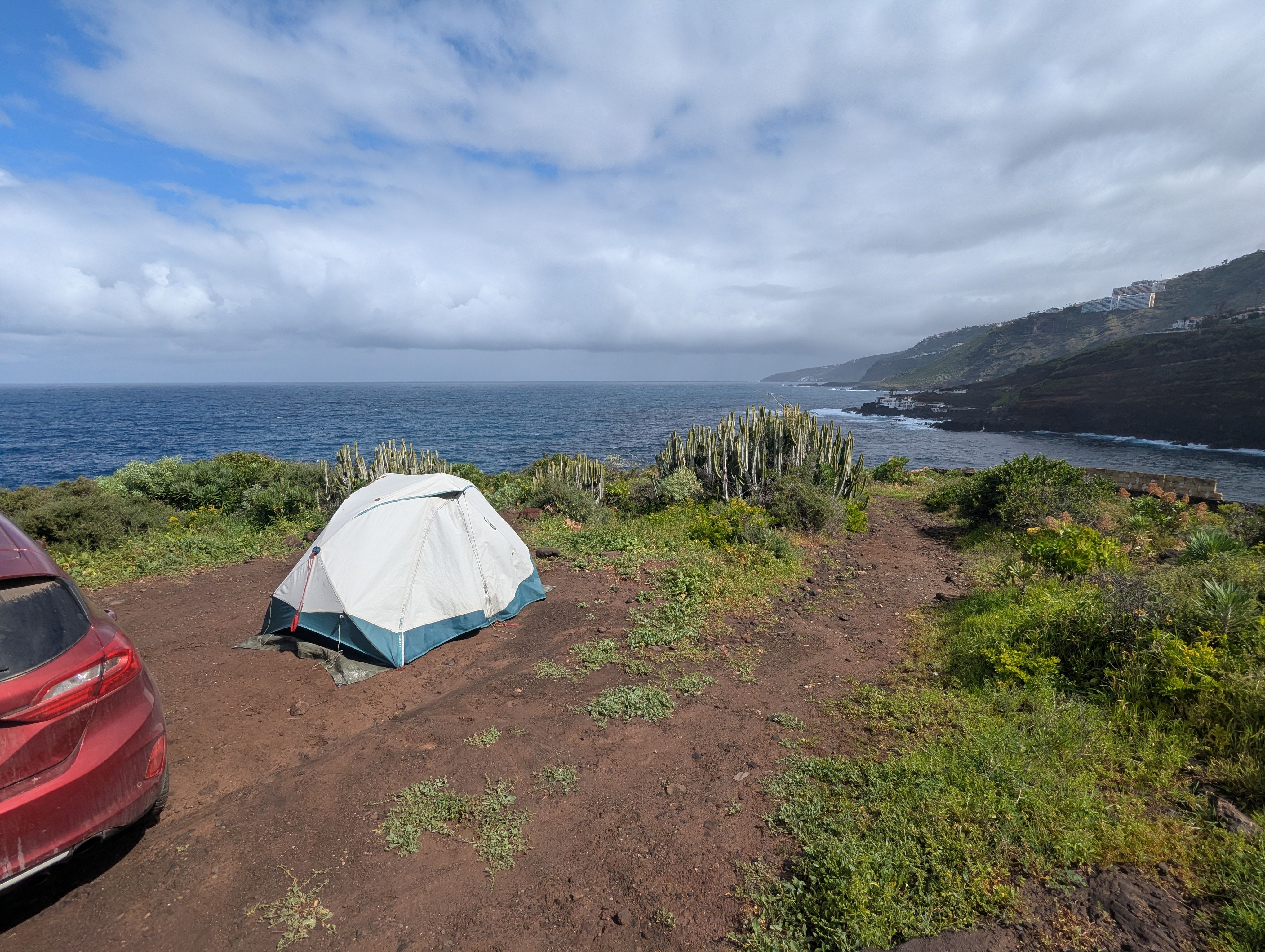
This is a guide I wrote to the lifestyle I am currently living.
AI non-usage notice
None of this text is AI output: I wrote the initial version of this text by hand on a phone keyboard with swiping inside my bed in my tent surrounded by grass and trees and later edited it in my car with my mechanical keyboard using my tablet with a view of the ocean on one side and the mountains on the other. AI LLMs have only been used to suggest topics to add and point out spelling errors.
Introduction
This is a guide to living in a nomadic and minimalistic way, in particular living in a car and a tent in Europe. It’s also partially applicable to living in a van or RV, and contains some extra information about a car-less tent setup.
It mostly consists of sharing my own experience and lifestyle as well as the research I have done to realize it.
Summary
The idea is to use a car to move, and a tent designed to be as fast to set up and tear down as possible that is pitched next to the car, sleeping for free in places found on the Park4Night app, by scouting them, or in communities or festivals, eating commodity food that doesn’t require preparation or cooking.
This minimizes dependency on society and money and allows one to travel very easily in a continent, while always being comfortable in your own tent and bed (moving between continents is possible with more effort by putting the vehicle contents in luggage, taking a plane and renting a vehicle on the other side).
My setup also includes a backpacking setup, designed to be able to attend rainbow gatherings and similar camping places that require carrying a tent in a backpack (I have 2 extra tents for this purpose).
Addressing common objections
Such a setup can elicit some immediate objections that are addressed here:
- It may be hard to find places to sleep or one has to pay campgrounds. No: with the Park4Night app it’s easy to find free places everywhere in Europe and even better places can later be found by looking on maps and driving around. I never actually had issues finding a place, although some places were only suitable for one or a few days.
- It may be illegal and it’s a big problem. No: in my experience police only came when I was in a nature reserve/national park area and even then in my experience it only means being woken up at 8-10am with them telling you to leave, with no fine or prosecution happening; hence, it’s only a rare and small hassle. In Europe, the map of all Natura 2000 areas allows one to avoid them.
- Setting up the tent at every stop is a huge hassle. No: with the Decathlon 2 Seconds Easy tent, it can be torn down leaving everything inside by opening the mattress valve, pushing two buttons on the tent, folding it in half and putting it on the car back seats. Setup is also easy by pulling two cords and using a powerful battery-powered pump to inflate the mattress
- The cold is a problem. No, if one moves to avoid it: sleeping in a tent is comfortable above around 15 C, acceptable above 10 C, doable above 0-5 C, possible with extra care below that. This is easily achieved by moving to southern Spain or the Canary Islands in winter.
- It’s dangerous. Seems not: nothing bad happened to me in a year, and I think that as long as one avoids large cities (or at least risky places there), the danger seems to be small or nonexistent. Carrying pepper spray can help ease worries a bit.
- Food is a hassle or expensive. No: you can get used to food that is cheap and doesn’t need preparation, such as rolled oats + rolled soy + raisins + multivitamin pills + salt
- The bathroom is a problem. No: it’s easy to find places to poop outside and wash with a bottle with a CuloClean attachment (you’ll be as clean as if you washed in a shower/bidet), and in urban areas one can poop at McDonald’s or similar easily and wash in the sink of the disabled bathroom
- You’ll be alone. Not necessarily: you can go to rainbow gatherings and “hippy” places, stay at communities or homestays, as well as pay for festivals or even head into a city and do city activities
- You need a large car. No: a B-segment car is enough for me, and it’s even possible to live in 2 people in one
- It’s expensive. No: after initial setup, the only costs are food (quite cheap), gas if one travels and occasional maintenance. It’s certainly much cheaper than renting an apartment if one doesn’t travel excessively.
Detailed setup and guide
Tent and bed setup
Tent and procedure
I use a Decathlon 2 Seconds Easy Fresh&Black tent (NOT one of the circular-shaped ones called “2 seconds” but not “easy”, which are infamous for being hard to close and are a completely different technology that is not suitable) because it’s the one with the fastest setup I could find (it also happens to be cheap and very easy to replace).
I use the 2 person variant since the 3 person one is too unwieldy to be reasonable to use alone, although I used the 3 person variant for a brief time where I lived together with another person in the same tent. The 2-person variant is still large enough to fit an ~80cm and a ~70cm mattress side by side. I use the Fresh&Black version so I can sleep longer in the morning.
I modified it by attaching colored carabiners to the corner loops to easily tell the head end from the foot end, and tied the side guylines to the vestibule loop and then to pull loops of two MSR Groundhog Mini stakes, while also securing that to a carabiner attached to the vestibule loop, creating a loop of cord where a rock can be inserted, if I prefer to do that instead of hammering the stake in the ground.
Teardown procedure (assuming no rain):
- While laying on the mattress, open the “out” vent and wait until the body weight fully deflates the mattress
- Wear clothes if necessary
- Exit the tent, moving the daypack outside (include food, water, any extra clothes, and any battery that needs to be changed using the car alternator), as well as any bulky or heavy objects that don’t need to stay in the tent
- Optionally, empty the pee bottle if it’s significantly full
- Close all tent door zippers
- Untie the head button cord and push the button to collapse the head end
- Move to the foot end, unstake any corner stakes if you put them, and do the same, then rotate the collapsed pole “umbrella” to be in the horizontal plane and in a diagonal direction
- Start folding the tent in half (eventually folding the foot end over the head end) moving the foot end to be vertical with you in the middle of the tent footprint
- Pull out the side stakes and tuck in the sides of the tent
- Make the head side collapsed pole “umbrella” horizontal in the other diagonal direction, then finish folding the tent
- Remove the stakes on the head corners if any and sit on the folded tent to flatten it down
- Move the car so that the rear door in open position is next to the folded tent; if needed, rearrange things on the back seat to prepare for putting the tent on top
- Shove the folded tent into the back seats
- Fold the footprint and put it in the car
- Close the car, perform a final check to ensure nothing is being forgotten on the ground
- Enter the car and drive away
It looks long because it’s detailed, but can be performed in 5 minutes.
If there is rain, I ideally wait until it’s not raining and also until the tent dries in the sun. If it’s sunny but the tent bottom is wet, it’s possible to leave it in the sun after folding to dry, and then flip the tent to dry the other half, and then flip again. If it’s raining, I put a tarp inside the car to reduce soaking.
Setup procedure:
- Take out the footprint, scout the area for a suitable place (described separately) and put down the footprint there
- Move the car so that the open rear door is next to the footprint head, and with the car oriented so that the tent orientation will be correct if possible
- Take out the tent putting it at the head edge of the footprint. If you couldn’t place the car ideally, rotate the tent 180 degrees. Adjust the tent on the footprint
- Unfold the tent and pull the cords at both ends to raise it
- If there can be other people around, tie the cords around the plastic. This ensures that even if a stranger such as a child pushes the buttons, the tent will not collapse on you since the mechanism won’t trigger because the knot and cord hold the rod back
- If desired, stake the tent corners. I usually only stake the tent if there is significant wind expected or if I plan to leave the tent there or stay in a spot for many days.
- Hold the vestibule in place, either by hammering the stakes in or by putting a rock inside the loop. You can skip this if you don’t care about better ventilation and are sure it won’t rain.
- Move in the daypack, generally including water, food, and optionally a phone and battery for the phone
- Move the car to the best position next to the tent (as described separately)
- In the tent, clear the bed from any objects that aren’t supposed to be there
- Close the out valve and open the in valve in the mattress, then inflate the mattress with the battery-powered electric pump
- Take off your clothes and enter the bed
- Laying on the mattress, adjust the inflation level by letting some air by pushing on the in valve and close the in valve
- If the bed isn’t level, put extra materials under it to level it
- Prepare to sleep
Tent spot selection and car placement
For tent spot selection, you generally want to find a spot that is:
- As flat as possible
- Isn’t likely to form a pool of water if rain is possible (in particular avoid wet or dried mud or concave pool-like depressions)
- In shade if possible (meaning ideally under a tree, and with a line of trees to the east and maybe south as well - or north if in the southern hemisphere)
- Not below a dead tree branch or other potentially falling objects
- If a thunderstorm is possible, such that the tent is not the tallest object or close to a lone tallest tree or object
- If wind is possible, in a place with trees or hillsides or other structures nearby that can break the wind
- Far from noise sources such as a road
- Not too close to other tents or vans if present
I generally orient the tent so that the head side is higher than the foot side and the sideways gradient is absent or relatively small. I use a cord and rope level to check, and if it’s a place I plan to stay more than one night, I use a small plywood plank to scrape the terrain, to even it out and also level it if necessary.
As you put down the footprint, check whether there are any sizable rocks under it, which you should remove. Also check for any thick sharp wooden sticks standing up, which can be present if vegetation other than grass has been mowed with a sickle or a lawnmower, which can easily puncture the tent since they act as a spear. If there are some, try to forcefully pull them out including the roots; if that’s impossible or there are too many, choose a different tent spot.
The car should be positioned next to the tent, to achieve the most important to you of these goals:
- Hide the tent from people passing in the main road or path nearby if it’s feasible (this is generally the main consideration)
- Make it impossible to hit the tent with a vehicle without first hitting the car
- Shelter the tent from the wind
- Shade the tent from early morning sun
Also make sure to minimize the chance that the car will be stuck in mud if rain is possible:
- Try not to park with wheels in existing dry or wet mud, or in very locally uneven spots
- Position the car so it has clear space both in front and in the back, so you can rock back and forward if needed to skip some mud
- Orient the car so that the drive wheels (the front ones in common FWD cars) are in the wheel position that is less likely to have traction problems
Bed system
My bed system is centered on using a 5cm memory foam topper. This provides a bed that is almost as comfortable as a good home bed (and more than a mediocre home bed), but makes the system more complex and heavier. However, this is not an issue for the car tent because the bed is left made, and for the backpacking setup it’s still possible to carry the topper and all gear in a 20kg 100L backpack, albeit not very comfortably. It is however unsuitable for thru-hiking or long backpacking trips, but I just don’t do those.
I make the bed in two different ways depending on whether night-time temperature is usually above or below 15C (note that I assume above 0 C in this guide).
I use an 80cm wide 5cm tall memory foam topper with a cover, which is placed on top of an air mattress. I cut the memory foam with a bread knife on the corners of the head side so that it takes less space inside the hood.
I use the Exped Megamat 12 LXW since it’s the thickest air pad I could find, inflating it with a large Flextailgear pump (or a Tiny Pump in the backpacking setup).
I tried self-inflating mattresses (such as the Exped Megamat Max 15 and Nemo Roamer) and don’t recommend them, since they are too hard to deflate and make the tent too bulky and heavy to put in the car easily, while not providing significantly more comfort due to the presence of the memory foam topper. If one doesn’t use a topper they can be a consideration.
I use a ZenBivy quilt as the main quilt in cold conditions and Kammok Firebelly and Bobcat quilts for warmer nights, or as additional quilts for very cold ones, and backups (any flat quilt will work).
I use high thread-count cotton bottom and top sheets designed for home bedding. You can also consider satin silk sheets, which are a bit lighter; I tried them and they feel too slippery or too rough for me, and the directionality of the weave causes scraping I don’t like. Other fabrics like linen can also be good. Bag liners designed for camping are even lighter but they generally have ridiculously low thread counts and can’t be tucked, and are thus uncomfortable for me.
The bottom sheet has elastic corners, while the top sheet is 230cm wide so that it can be tucked under the mattress (you generally need to leave 15cm of extra width and tuck 30cm, giving 30+12+5+15+80+15+5+12+30 = 204cm minimum width).
I have also made some cord straps using microcord and two micro-carabiners, tying an adjustable grip hitch to allow length adjustment and bought elastic straps.
I use a silicone sheet bought on AliExpress (and formerly used a bunch of silicone cooking mats) below the bed to increase friction and make it harder for it to slide on the tent floor and for the sheets to untuck in the home-like configuration.
High temperature “home-like” bed
The high temperature bed is made like a home bed, with the mattress below, the topper above it strapped to it (I use an extra elastic strap to connect the two topper straps on each end), the bottom sheet wrapping them both (I use an extra horizontal elastic strap in the middle), the top sheet tucked under the mattress and the quilt draped on top, optionally using the cord straps to hold it to the mattress. I also optionally use a fleece blanket between the sheets and the quilt or alone if the night is too cold to just use sheets but too warm for the lightest quilt, and am considering a cellular cotton blanket as a further step between the bare cotton sheet and the fleece blanket.
This makes it extremely comfortable and simple, prevents the topper from sliding and allows one to quickly remove the quilt if it’s too hot, but has the disadvantage that the sheets and quilts touch the ground, and is thus less warm than a traditional camping setup; furthermore it doesn’t support a hood and thus doesn’t warm the head.
Without a topper
You can use this without a memory foam topper with no modifications.
Low temperature “modified ZenBivy system” bed
The low temperature bed is a modified version of the ZenBivy system, adapted to fit having a memory foam topper inside the quilt.
Over the mattress, a ZenBivy hooded sheet is installed in the standard way (make sure to choose one with a black hood that is opaque to light - you might need to buy it used).
A second ZenBivy hooded half sheet is installed in a non-standard way on the foot end, to hold the topper in place and provide extra warmth to the feet; it is secured to the other hooded sheet using a cord strap per side.
The topper is placed over the ZenBivy sheets (not strapped), the bottom sheet is installed wrapping only the topper, and top sheet is also installed and tucked under the topper.
The ZenBivy convertible quilt is placed over the topper assembly and attached to the first sheet in the standard way; the foot box is formed in a non-standard way by attaching two hooks on each side and then tucking the quilt under the topper at the foot end and sides and fastening the string; finally, the sides are also tucked and horizontal cord straps are used to connect both sides of the quilt under the topper.
Note that the topper assembly is not well secured to the mattress and will thus tend to slide especially if the ground is not fully level: it’s necessary to get used to adjusting it by grabbing the sides of the mattress with your hands and moving one’s body to move the topper with it. I haven’t found a great solution to this since it seems to be impossible to strap the topper without cutting the hoods or sheets to pass straps through and putting silicone mats below the topper worsens the feel of the bed; the best solution might be to sew Velcro on the ZenBivy sheet on the bottom of the topper cover.
This setup has the advantage of feeling mostly like a home bed on the inside, while being warmer and having the integrated hood; however, it has the disadvantage of having the topper slide, the bottom sheet forming creases since the thin mattress doesn’t hold it well and the fact that it’s much more time consuming to fully remove the quilt on hot mornings; the home-like setup is thus much better if temperatures are warm.
I also tried a sleeping pad with sleeves (Big Agnes Diamond Park), but I feel that the modified ZenBivy system is better since the quilt is usable without the hood, it has a wider foot area and it raises up the topper in the edges less, and the lateral tightness is more adjustable. The modified ZenBivy system is more complex though and requires making the microcord straps.
Without a topper
This method fundamentally requires a memory foam topper since otherwise there is nothing to hold the cotton sheets and keep the footbox attached to the mattress.
Instead, without a topper, the ZenBivy quilts can be used in the manufacturer-recommended way, either laying on the ZenBivy sheet and using a quilt liner as the top sheet, or using a sleeping bag liner, travel sheet or a sheet sewn to form a tube.
You should probably use cord straps to fix to the bottom part of the quilt to the mattress so that pushing up with your legs or feet doesn’t result in the quilt lifting up and letting in cold air.
Tent cold protection
The tent itself raises the temperature a little bit (2-3 C it seems) due to the solid inner and if I’m still cold I enter the bed and the cotton sheets and main quilts insulate my body, and I can use my two extra quilts for extra warmth. From the ground the thick mattress and memory foam topper are enough to insulate at any reasonable temperature (the mattress alone is rated for -20 C).
I sleep and stay in the bed naked, but if the temperature is quite cold (under 10 C) I enter the bed while still wearing the base layers, fully cover myself with the quilt and hood to maximize bed heating speed and only then remove all clothes.
If the temperature were extremely cold, I could sleep with clothes, but I would rather not be in such a climate.
Note that below around 10 C exiting the bed naked to pee in the bottle becomes uncomfortable, so I first put on my shirt or sarong. Reportedly people who sleep at well below freezing keep their pee bottles inside the bed.
Tent rain protection
The tent fully protects the occupants from the rain, but some care is needed.
If rain is possible, I try to make sure the tent is closed and shoes are fully inside the vestibule when it starts raining or before going to sleep if a non-zero chance of rain is forecast; also I try to make sure, if the footprint tarp is larger than the tent, to fold the excess under the tent to prevent a pool forming. I also check the outer tent for any holes and patch them using outdoor gear repair tape.
Tent sun protection
The Fresh&Black tent reflects a bit of sunlight and doesn’t let it in unlike other tents which are almost transparent to it; however, it will still be significantly heated by direct sun exposure. Direct sun exposure also degrades the tent due to UV radiation, but the Decathlon tent is cheap enough that you can just buy another one as needed, and I think it’s also TiO2 covered, which makes it quite resistant (if you use a more expensive tent, you may want to put a tarp over it if you leave it in the sun to protect it)
If the sun is making it too hot I remove quilts if I want to resume sleeping; otherwise I open the doors to ventilate and leave the tent if it’s still too hot.
If I want to sleep later than this allows or stay in the tent all day and finding a shaded spot is not an option, I carry poles (Durston carbon fiber poles) and reflective tarps (Bushmen Thermo-Tarp) which I can use to erect an A-frame tarp over my tent using the car as one of its sides; a pop-up canopy with poles like those sold at Decathlon is also an option.
Tent wind protection
The tent fully protects the occupants from the wind, but can be swayed and jerk around especially if there are wind gusts.
If significant wind is expected or happening, I stake the tent, and also have added extra side guylines to stabilize it more, since the sides are more vulnerable in the Decathlon Easy tent design.
Before choosing where to stay, I look at the highest resolution weather forecast available and try to avoid places with very high wind gusts at night.
Tent lightning protection
Tents don’t provide any lightning protection, and it’s best to avoid staying where thunderstorms are expected.
If unavoidable, I try to place the tent so it’s not the tallest object and not close to isolated tallest trees.
If I don’t feel safe, I will shelter in my car. Note that while the car protects the occupants (if it has a metal top), the car electrical systems and tyres get damaged by lightning, so it’s best to avoid this situation altogether.
Tent insect protection
Tents protect against insects as long as the inner is closed.
I generally find that insects are not an issue for me and even having a few spiders or flying insects in the tent doesn’t bother me too much, so I often keep it open for ventilation and don’t try to minimize openness when transferring myself and objects in and out, although I try to remember to close it when leaving the tent or if there’s no reason to have it open.
Sleep noise protection
Tents only provide slight noise dampening.
For noise, I use Moldex 7700 foam earplugs. When in particularly noisy environments (e.g. if drums or subwoofer bass is audible), I make sure to squeeze them in a tiny cylindrical shape before insertion and push them in as far as possible; once the foam has expanded I then again push them in as much as possible. This needs to be done carefully: it’s normal to feel pressure on the eardrum, but if it’s constantly painful then it should be reinserted.
Sleep light protection
The Fresh&Black tent greatly limits light (requiring artificial light even in the day if the rainfly is closed), but the interior is not at all pitch black, due to light leakage below the rainfly and from the vents (hard to avoid without compromising ventilation), as well as many little “pinhole” imperfections and small damage in the black covering of the rainfly.
I use an adjustable Nite Hood to further block light, which is a cotton hood that blocks light while being more comfortable than traditional sleep masks. If one only sleeps on the back, then a traditional sleep mask might also be fine. Note that light is also blocked by the ZenBivy hood if present, and by the Fresh&Black tent or the reflective tarp in the camping setup
I take melatonin (orally soluble strips) in the late evening if I feel like I need to adjust my sleep cycle backwards or if I feel I might have trouble sleeping.
Vehicle setup
Vehicle
I use a relatively small B-segment car, which is still large enough for this lifestyle. If one already has a vehicle, it’s probably best to just use it unless it’s extremely small.
If acquiring one, ideally one would want a car that is a bit bigger and ideally an off-road vehicle or at least a car with high ground clearance, although these aren’t mandatory. I require an automatic transmission since I find manual transmissions unacceptably tedious and fatiguing, but people who are used to them might find them acceptable. I also recommend speed limiter and cruise control features (preferably adaptive) to make driving the whole day on highways much more relaxing and feasible. Automated emergency braking is also highly recommended.
A self-driving car would be even better, but only if it’s actually fully autonomous, since those that sporadically require human attention are extremely dangerous (you’ll get used to not paying attention and won’t manage to react in time when necessary).
I modified the car in these ways:
- Added a digital rear-view mirror by installing a Wolfbox mirror dashcam. This is pretty essential since it allows me to fully load the car up to the roof while still being able to see behind, unlike with the built-in optical rear-view mirror.
- Bought a Noco jump starter pack, which is important since it’s easy to accidentally run down the battery. I also carry battery cables.
- Added a USB charger for the 12V lighter port, which delivers significantly more power than the car’s built-in ports.
- Installed a HEPA-level air filter, which is important when staying in the Canary Islands to handle episodes of Calima, i.e. Saharan dust saturating the air
- I’m planning to replace the battery with a dual-purpose AGM battery that is more resilient to discharge, and possibly add a solar charger for it
- My back seat and trunk glass is darkened; otherwise, I recommend installing dark film to make objects inside harder to see.
If there’s any possibility of staying in relatively cold climates, it’s important to install premium all-season tyres so one doesn’t need to carry an extra set of tyres or return to a fixed place twice a year.
If going to other countries (as is typical in Europe), it’s critical to make sure to have any mandatory inspection performed before one leaves, so you have the most time possible before you have to return to the country where the vehicle is registered.
I carry my car keys in a Faraday cage pouch, which can be pretty important for keyless entry cars since otherwise the keys in the tent might be close enough to the car to make it possible to open it for anyone (and it also protects from replay attacks).
If the car has a tow hook, a suitable towing chain or cable is a good idea.
Securing the car can also be a good idea since theft would be catastrophic, in particular hardening the OBD port, installing kill switches and satellite trackers
Storage and objects
In the trunk, I put a large clamshell suitcase, where clothes are stored in one side and miscellaneous objects on the other, oriented so that it can be opened with the top stuck over the trunk’s edge. On top, I have a large duffel, storing mostly camping gear (extra tents, mattresses, tarps, poles, ropes). To the side, I have electrical cables and a plastic bag with miscellaneous items.
For the backseats, I use large black plastic garbage bags to store objects, so that they are harder to notice from outside with darkened windows or so they might look like worthless garbage (but make sure to never leave those bags outside where someone might mistake them for garbage to take away).
In the backseat foot area, one side is used to store food and the other for shoes, daypacks, sacks, clothes and other quick access objects. On the backseats I have a foldable aluminum cart with my hiking backpack on top, and the solar panels and then tent above that.
The front passenger seat is used for temporary storage, with the foot area used for water jugs or tanks.
Living in the vehicle
I use my car to perform work requiring a keyboard and tablet: to do so I fix the tablet to the steering wheel using a tablet stand in a non-standard way, and then use a tenkeyless mechanical USB-C keyboard on my lap. When not in shade, I cover the windscreen with black plastic and orient the car so that the sun never shines on the driver’s side (which means facing approximately east in the northern hemisphere) which allows me to open the driver’s door or window for increased ventilation, as well as the opposite window.
Another possibility is to turn the car so that the sun is in the back. However, I found this suitable only when staying briefly in the car, since otherwise it requires multiple adjustments per day, which is annoying and also drains the battery.
Driving
Driving can be more challenging than usual, since quite a bit of driving will be on unpaved roads to reach spots to put the tent, so I present some advice for that.
As described in the safety section, just because there is a road it doesn’t mean that one can actually successfully drive on it.
Highways are usually fine: the best strategy is to drive with cruise control in the middle lane, so that one doesn’t have to handle vehicles merging in or very fast vehicles in the left lane and there is margin in case one fails to stay in the lane. On long trips, it’s a good idea to engage the cruise control as soon as possible and make sure one’s posture is good, to avoid tiring the feet, legs or backs excessively.
On other roads it’s necessary to watch out for potholes: try to avoid them and if a road has many, drive very slowly (5-10 km/h for the worst cases) and plan your path, exiting the vehicle if necessary. If you accidentally hit one at speed, check the tyre pressure sensors to make sure you didn’t slash any tyre, and if you did, change it with your spare wheel using the included kit.
On unpaved roads, ground clearance can be an issue: if the road is uneven, plan a path so that the ground between the wheels is not much higher than the ground the wheels will tread. If it’s not clear whether clearance is enough, drive very slowly and back up if you hear and feel the middle of the car hitting the ground. You will have to give up continuing on the road and turn back if there’s no viable path.
Obstacles like big rocks can be a problem, and they should be treated like potholes; if they cause a ground clearance problem and there is no other path you may need to try to move them by foot. If an obstacle is too heavy and one really needs to pass it’s possible in principle to tie a rope to it, wrapping it around a tree and using a chain of trucker’s hitches to obtain mechanical advantage.
A further issue is water. If you can’t tell how deep the water is visually and can’t avoid it, you need to exit the vehicle and check manually with a stick. Water over 10cm is best avoided; if you really want to pass it anyway, research your vehicle’s wading depth and don’t exceed it since doing so will destroy the engine or electronics. To cross deep water you need a fully sealed vehicle with a water bra and snorkel, heavy enough to not float. If the water is too deep, you have to give up continuing on the road and turn back.
Driving in water, thick mud, ice patches or sand may result in loss of traction. If it’s a short patch and there are no doubts about ground clearance, the best strategy is to pick up enough speed to make it through the patch even without traction. Otherwise, unless you have AWD and specific tyres (all-terrain/mud/paddle for mud and sand, studded for ice) which can give you traction you will need to give up and turn back.
Snow is a further issue: assuming you have premium all-season tyres, they will work acceptably on snow at moderate speeds.
Traveling and what to do
Finding places to sleep
The best way to find places to sleep at least in Europe without doing significant work yourself is currently the Park4Night app: I recommend filtering by “surrounded by nature” and the highest rating that gets results. Note that the app is mostly for people with vans, but at least the places in nature are usually quite good with a car+tent setup as well.
When you are starting out and testing your initial setup, paid campgrounds are perhaps better if you can afford it. I started at one, but never paid again for campgrounds after the initial testing phase.
I prefer more natural places, but keep in mind that the tent can be pitched on the asphalt (with a footprint) and that if you pitch the tent behind the car perpendicularly, the resulting tent+car is as large as a camper RV, so anywhere a camper RV can park, you can park too.
Scouting for places to sleep
While Park4Night is good for new areas, there can often be good places that aren’t listed there. The way I find places manually is to first have some concept of what I would like in a place that the current places I know about don’t have, and use satellite maps, as well as street view and OSM slope maps, to find likely locations that fit the concept. Note that usually viable places tend to be places with unpaved dirt that are reachable with roads and thus identifiable by a light brown color and a visible path; you can also look for vans parked in such areas in the satellite photos, which indicates a usable spot. Note that often roads that look promising can actually be blocked with gates or barriers that can be hard to see on satellite maps, so make sure to zoom in and check for that, using street view if available. Once an area has been determined by looking at maps, I drive there and drive on pretty much all the possible roads in the zone, inspecting it and looking for exact places. Once candidate places have been found, it can be a good idea to research whether the place could be in use for something that will conflict with you staying in a tent, and staying there for an hour or so to see if there is any unforeseen issue, like more vehicles than expected driving close.
Body maintenance
Food
For food, I mainly eat standardized cheap food (that happens to be vegan) that doesn’t need preparation and lasts very long, since this allows me to not worry about it and guarantee I always have food to eat. For variety I also buy some random food at supermarkets or in shops.
Main food strategy
I prepare two large 2kg zip-loc bags at once, mixing in each:
- Two 500g bags of rolled oat flakes (source of carbohydrates) - preferably large-sized
- One 500g bag of rolled soy flakes (source of protein and fats)
- One 500g bag of raisins (source of sugar and flavoring)
To mix them, I empty the contents in the big zip-loc, close it leaving as much air as possible in, then rotate it and flip it in different directions until the contents are visually mixed.
In addition I take every day 2 different multivitamin pills (to hedge the risk of either being manufactured wrong, and provide a better quantity), an Omega 3-6-9 supplement (might not be needed) and a salt source, currently in the form of 2-4 Decathlon salt pills.
I then regularly transfer the mixed food to smaller zip-loc bags I keep in my daypack, my tent and my car, and eat it from the bag by pouring it into my mouth as if it were a fluid. I keep the pills in a pill holder so I can know whether I took them already and use a medicine tracker app on the phone.
This allows me to effectively eat at any time I’m hungry with no preparation whatsoever and eat whatever quantity I feel like.
I have checked with a spreadsheet and this food is indeed a complete diet, providing macronutrients in the recommended ranges, plenty of protein and all essential amino acids and enough LA and ALA essential fatty acids, as well as minerals (with a deficit of calcium that is addressed by water and multivitamins); vitamins are instead covered by the two multivitamin pills, as long as you choose them reasonably. 2 multivitamin pills don’t seem to pose a risk of taking too much of anything (vitamin B6 seems the one to watch).
Soy flakes are the hardest to source, and generally need to be bought on Amazon, from online shops or in supermarkets specializing in Asian food; they are by far the hardest item to source and thus it’s important to make sure to keep a good supply. If they can’t be sourced, eating nuts of various kinds or other soy products can be a temporary replacement. Note that the bottleneck appears to be companies interested in processing soybeans into soy flakes, since soybeans are obviously commonplace, and processing machines probably are as well since they are used for rolled oats, which are also commonplace.
Soy flake brands:
- Alnatura (German) - sold by amazon.de, piccantino.es, piccantino.it
- dmBio (German) - sold by their online shop
- Bongiovanni (Italian) - sold by amazon.it, tibiona.it
- Streich-Mühle (German - maybe not organic?) - sold by their online shop
- EnerBIO Rossmann (German) - sold by Rossmann supermarkets and in their online shop
- KoRo (German) - sold by their online shop
- Spielberger Mühle (German)
Oats and raisins are easily found in any supermarket, however it can be challenging to find reasonably priced organic ones and also I think large-size oats are better since they are less dusty and more enjoyable to eat, but sometimes only chopped-up/small ones are available. Hence, it can be wise to buy them online as well together with the soy flakes.
Multivitamins and supplements can be bought in hypermarkets or pharmacies and electrolyte/salt tablets can also be bought from Decathlon.
I also keep a bag of raisins to eat if I want sugar, and a bag of soy flakes to eat if I want fats or proteins.
Supplements and multivitamins
Since the diet doesn’t include regular consumption fruits or vegetables, it is critical to supplement properly (and also a good idea to eat fruit and vegetables if possible, but I strongly recommend to assume none will be eaten). I currently use two multivitamins to hedge against the risk of either being mis-manufactured and use a spreadsheet to check that all nutrients are covered. Currently using Swisse Ultivite and Solgar Male Multiple, although they aren’t necessarily the best choice overall.
It is best to make sure that at least one of them has Vitamin A in the form of beta-carotene rather than retinol, since high doses of retinol are potentially harmful, and two multivitamins can be enough to go over the limit.
Also, the diet is fully vegan, so it’s a good idea to ensure that at least one multivitamin has enough vitamin B12. While the RDA is 2.5 ug, it is recommended to take at least 100-200 ug daily for vegans since absorption is variable between people and high levels of vitamin B12 don’t seem harmful.
The diet is pretty much fully sodium/salt-free, unlike common mainstream diets that have too much salt, but a low quantity of salt is essential for humans, so a source of salt needs to be added. I use salt pills from Decathlon: 2-4 should be taken per day.
In general, you should use a spreadsheet to make sure that you are taking enough of every single nutrient.
Alternative food strategies
I don’t use these currently, but I’m including them for completeness.
Powdered food
An alternative are meal replacements such as Soylent, Huel and Jimmy Joy products. These however have the drawback that the powder form requires extremely tedious preparation (every time a shaker needs to be filled, consumed and washed). They are also of course ultra-processed food although they are designed to be healthy.
Instead of the branded meal replacements, it’s possible to buy soy or whey protein powder, powdered oats and some oil to ingest separately with a spoon, but this is even more tedious than branded powder since you’ll need to mix components.
Meal replacement bars
Some meal replacement brands such as Jimmy Joy make solid bars, which are far more convenient than the powdered form, and have similar or greater convenience than my own food. However, they are absurdly expensive, and are ultra-processed food and generally less healthy than the powdered form due to the need to include binders to make them solid.
Simple cooked food
Another option is simple cooked food like rice and lentils, which has the advantage of being the absolute cheapest bought option, but requires very tedious cooking and plate washing, as well as soaking for legumes.
Common supermarket food
It’s also possible to just buy miscellaneous food in a supermarket. However, eating lots of different types of food makes it hard to track which and how much you eat and have left, and is less space efficient than bulk foods. A lot of food sold in supermarkets is unsuitable to be used as a staple food in a car setup because it either spoils fast or requires refrigeration, or is impossible to eat without washing utensils or producing lots of garbage, or is relatively expensive and generally unhealthy.
Dumpster diving
Dumpster diving is a way to get food for free, by taking food from supermarket dumpsters that has been discarded because it’s too close to the expiration date, because of cosmetic damage, because other fruit in the same container has spoiled or because it’s a baked good that would be too hardened on the next day. See dumpstermap for details.
Obviously this makes your food intake unpredictable, so if using this as a major food source you need to ensure that you are getting enough essential nutrients and in particular complete protein: you probably want to supplement with multivitamins and possibly minerals, and add soy flakes or soy/whey protein powder as needed.
Occasional food
Occasional food can be whatever one fancies, such as:
- Whatever food you found delicious to eat in the past (if easy to source)
- Fresh fruits and vegetables (I like bananas, grapes, apricots, tomatoes, raw peppers)
- Nuts and dried fruits (I like walnuts, peanuts and nut mixes, as well as raisins, dates and dried apricots)
- Baked goods and cookies
- Fast food (local street food, pizza, fast food chain food)
- TooGoodToGo food bags
Maintaining weight
The approach I use to very roughly maintain weight is, when unsure whether to eat or not, to choose depending on whether my weight is under or over my target weight band; I carry a wooden scale to weigh myself.
If that’s not enough, and one wants to precisely maintain or gain/lose weight, one can instead decide how much food to eat each day precisely and make sure you eat that amount. The food strategies described in this document make this very easy since you are eating a single kind of food prepared by yourself with very precise measurements.
Water
In my car, I usually keep, in the front passenger foot area, around 40-50L water, using either a bunch of 10L foldable tanks filled from water sources, or a bunch of 8-10L mineral water jugs bought at supermarkets. I fill the tanks at public fountains that I find using the OsmAnd app to find OpenStreetMap POIs tagged as “water”: I found that these are plentiful.
For drinking, I use a bunch of Decathlon 1L water bottles with a water filter. The water filter makes them safe even if bacteria develop in the bottles or tanks, and I found that the Decathlon design with the filter being constantly immersed in the water, makes the filters last very long without clogging (so far more than 6 months!), unlike the Sawyer Squeeze filter that clogs very easily; however, note that the Decathlon filter is 0.2 microns while the Sawyer filter is 0.1, and thus the Sawyer filter is more suitable for random possibly contaminated water sources.
Before switching to the Decathlon bottles, I used a 2L Cnoc Vecto-X with a Sawyer Squeeze filter, and also carried a spare water filter and backflush syringes. If one doesn’t want/need to filter the water, a titanium bottle from Keith or Vargo is also a fine option.
I recommend avoiding plastic bottles from non-reputable brands due to leaching concerns, glass bottles due to breakage risks, and steel or aluminum bottles since they leach (nickel/chromium and aluminum respectively) unlike titanium bottles.
Defecation
In nature
I usually defecate in nature: most good tent places tend to have some slopes with a bit of vegetation nearby, and so finding a place to defecate is usually a matter of going there (usually descending a bit) and finding a spot that is not directly on a path.
The conventional wisdom is to do it in a covered hole, which is a possibility. However, animals don’t do that and I find that just leaving it in the open is quite acceptable in relatively isolated places with large vegetation area. In sunny places the poop eventually dries and becomes a single solid piece: if I stay in a place for a long time, around every 2 weeks I take a plastic bag to the place where I poop and remove all the dried poop, and then throw the plastic bag in a large garbage dumpster.
Another possibility is to poop directly in a garbage bag, but I find that more tedious and less pleasant, and you still have to leave the garbage bags there until you move with the car; however, it can be a good option if there is no place where leaving the poop is reasonable.
If you instead want to use a hole, the easiest way is to pull out a stone that is already in the ground, leaving a hole that you can later cover with the stone itself. Alternatively, one can carry a shovel (a titanium one if you want to backpack with it) designed for this and first use the handle to cut a round patch of grass and the shovel to pull it out.
To defecate, squat and if needed trace a line with the hand from the anus to the ground to ensure aiming at the right place, and then defecate. Afterwards I find it can be a good idea to change positions and walk around a bit, since that often shifts the intestines, making further defecation possible. In case of diarrhea, it’s especially crucial to make sure to fully empty the intestines, so it’s good to take all the time needed.
To wash, I use a 1.5 liter common water bottle with a CuloClean cap, which I fill with a funnel from the water tanks. CuloClean also sells some plastic “hangers” to secure the device to the bottle when not in use. The Decathlon drinking water bottles can also be used, but there is some small risk of contamination.
To use it, squat and hold it in one hand, and wash with the other as if using a bidet or shower. Then, wash the hand itself using the multistep procedure recommended by health authorities.
In urbanized areas
While traveling in the car or if already there, the disabled bathrooms in McDonald’s and similar places are excellent, since they let you use them even if you are not disabled or don’t buy anything (except rare cases in which it’s locked) and they allow you to wash your anus in the sink after pooping, since both the sink and WC are behind the locked door. If that’s not available, then a small establishment with a single bathroom stall will also usually have a sink behind the locked door, although you will usually need to order and pay a small item to use the bathroom. Another possibility is to hold the main door of a multi-door bathroom closed with one hand while washing one’s anus with the other hand (obviously this requires to choose and time and place with few or no other people wanting to use the bathroom).
It is also possible to carry the bidet bottle in any bathroom and use it to wash in the bathroom stall itself: to do so, after defecating normally and flushing the toilet, one can raise the WC seat and squat over the WC while washing with the water bottle, and then flushing again. This is a bit more tedious than using a disabled bathroom but can be done in any bathroom.
Peeing
Outside, I simply pee using my penis and then wash it by dropping some water on it from a water bottle. If one doesn’t have a penis, it might be desirable to wash as described in the defecation section, or use a microfiber rag, either stored in a zip-loc bag or hung to dry.
In my tent, I use a 2L Nalgene Cantene pee bottle and clean up with a dedicated microfiber cloth.
If you don’t have a penis, you’ll probably either need to find an extra-wide mouth bottle or sealable container you can squat over or use a SheWee-like device and figure out how to handle the fact that it will be wet with the pee (store in an open plastic bag perhaps, or put it outside the tent)
Showering / body washing
Often, I stay in places next to the sea and wash myself by simply bathing in the sea.
The other possibility is to follow the washing instructions in the defecation section, but washing the armpits and a bit the rest of the body in addition to washing the anus and genitals.
The disabled bathroom of McDonald’s and similar is also suitable for washing armpits and genitals.
Washing in a stream is also possible if available: to wash in a stream, squat and also stretch one of the arms forward and put the hand and some weight on the ground, so the armpit is exposed, and use the other hand to carry water from the stream to it and rub it. If using a CuloClean bottle, hold it in the hand of the arm being washed and use the other hand to wash
Another option is to use a camping shower. A very lightweight option is an Exped Schnozzle bag plus the Schnozzle shower attachment; a simpler but much heavier option are the Decathlon camping showers. These can provide a limited warm shower by leaving the bags exposed to sunlight to warm them up, or by heating water in a pot on a fire (being careful to dilute the water if it’s too hot). I don’t do this because it’s too tedious, even though I have tried both of those systems.
I generally don’t take normal showers, but these are the options to do so:
- Free RV parking areas with showers: you can find these in Park4Night filtering for showers
- Highway truck stops: some are also on Park4Night or you can use the TransParking and TruckFly apps that let you filter for those that are free and with showers
- Campgrounds and paid RV areas: it can often be possible to enter, go straight to the showers and leave without anyone noticing, pretend to have come to ask for information if questioned. Alternatively, asking and perhaps paying a small fee is an option.
- Gym chains: McFit currently is 420 per year, 50 per month or 20 daily; Basic-Fit is 35 per month. Particularly useful if you need to shower frequently due to participation in mainstream social activities in cities
- Swimming pools: usually cheaper than gyms for a single entry
- Swinger spas if you can qualify as a woman: can be free or cheap (as a non-woman, generally overpriced)
- Gay male saunas if you can qualify as a man: cost is usually around 20 euro
- Non-sexual spas also an option but usually more expensive than swimming pools
- Private beach showers
- Marinas
- Public beach showers: usually not heated
Environmental protection outside the tent and clothing
Clothes and cold protection
The natural state of animals and human beings is to be naked, and I recommend to be naked whenever possible. This saves all effort needed to wear and wash clothes, is more pleasant and makes receiving touch easier and better.
To carry stuff when naked, I often use the daypack (I use the Osprey ultralight daypack; the Sea to Summit Ultra-Sil Nano has better feel on bare skin, but it breaks very easily), and also use an anklet to carry my car keys as well as condoms.
However, often it will be too cold to be naked all day, or it is illegal or disapproved to be naked, so I bring a full set of clothes.
I bought most of them at Decathlon and I recommend doing so since you can try them, you can buy more or replace clothes anywhere, it’s cheap and quality is pretty good even though perhaps not the absolute best.
For protection from cold I use these clothes, also in the backpacking setup, listed in the order you should wear them (note that social conditioning says to cover genitals first, but for cold protection a shirt is the first item since the core is more susceptible than the legs):
- Top baselayer: long-sleeved merino wool shirt (Decathlon). Cotton is a bad choice because it doesn’t insulate when wet and doesn’t dry easily and pure polyester/nylon is a bad choice because it smells bad when sweaty, leaving merino wool as the only viable choice. Long-sleeve is of course better than short sleeve for cold protection
- Shoes: usually sandals from Decathlon, or sock shoes (Skinners) unless heavier shoes are needed (see separate shoe section)
- Bottom baselayer. This has several options:
- Light polyester pants (Amazon) (or merino wool if you can find them) Looks good, but not as warm as thermal underwear
- Merino wool thermal underwear (Decathlon). This is the best thermally, but can be uncomfortable and fragile to wear alone. I don’t use it.
- Sarong/Pareo (Amazon). This is nice, can be put on/off while keeping shoes and can be used for other purposes, like as a tarp to sit on. However, it can be colder and less easy to move in than pants, and can’t be used under other pants
- Top midlayer: fleece midlayer (Decathlon) (or merino wool sweater), preferably with a neck zip. This is to be used when the cold is due to low temperature, and provides insulation without being too bulky
- Top shell: light wind shirt (Decathlon). This is essentially a waterproof shirt with holes, which blocks the wind while still allowing transpiration. This is to be used when feeling cold due to the wind; it also provides partial protection from rain and water splashes
- Bottom midlayer: fleece pants (Amazon). This provides insulation, but can be skipped if the temperature is not too low
- Bottom shell: hiking pants (Decathlon). This provides wind protection and some insulation
- Socks: Merino wool socks (Smartwool)
- Top outer layer: light down jacket (Decathlon). This is for when it’s very cold or just cold and you are standing still
- Gloves: fleece gloves (Decathlon)
- If still cold, the weather is too inhospitable. Bed quilts can be used as a temporary measure before moving elsewhere. If you want to stay, read Skurka’s book “The Ultimate Hiker’s Gear Guide: Tools & Techniques to Hit the Trail” and in particular consider heavier down jackets, a shell over the jacket, headgear, scarves, gaiters, fur linings on openings, down pants, down socks or insulated shoe liners, VBLs.
Shoes and ground protection
Being barefoot is best, but often it’s unpleasant due to thorns, glass shards, gravel, abrasive rocks, cold ground, ground that is too hot, wet ground, muddy ground or dirty ground.
My shoes and ground protection:
- Foam sit pad (Decathlon): I use this to sit on cold ground
- Sock shoes (Skinners): these are good to protect the foot while being as small as possible. However, they are unsuitable on wet grass or muddy ground since the upper and inside gets soaked
- Sandals (Decathlon): these are thicker and less comfortable than sock shoes, but don’t have their water problem, although the foot still gets wet, so they are only good for warm temperature. They don’t protect the foot from the sun, which can be a problem on long journeys
- Sandals + sock shoes inside them: this allows one to protect the feet from the sun and also to switch to only sock shoes on soft terrain and to only sandals in the water
- Trail running shoes (Amazon): these offer better protection, more water resistance and more insulation than sock shoes, but are still vulnerable to water and mud puddles and a bit vulnerable to rock edges
- Waterproof hiking boots (sport retailer): I use these when I need to hike somewhere and must reach the destination on unknown terrain, or if on known muddy terrain or to walk in shallow streams; they are basically immune to everything except water or mud deep enough to reach the shoelace knot, and mine have a Vibram sole that can be trusted to handle slopes
Dress code clothes
For the purpose of complying with general mainstream social norms I use these (outside those norms, it’s mostly not worth to carry these since outside of very specific conditions it’s better to either be naked or wear more protective clothes):
- Shorts with pocket zips (Decathlon)
- Short-sleeved Merino wool shirt (Icebreaker). The Icebreaker 100% wool shirts have more comfortable collars than the Decathlon blends
- If you have female-like breasts, a bra-like top can also be useful
To comply with dress codes, I recommend those if you envision attending these events (note that for sex-positive events full nudity is a great option if allowed):
- Fun/colored polyester shirts: for mainstream events
- Fun/colored/shiny pants: for mainstream dance/fun and kinky/sex-positive events
- Fun/colored trail running or running shoes: for mainstream and kinky/sex-positive events
- Colored dress shirts: for mainstream events requiring a dress shirt
- Transparent/lace shirt or bra: for kinky/sex-positive events
- Transparent/lace underwear: kinky/sex-positive events
- White dress shirt: for formal events
- Black dress pants: for formal events
- Black leather shoes: for both formal and kinky events
- Robes/kimonos: for neo-Tantra/“temple” events
Rain protection
For the rain, I use an Euroschirm silver hiking umbrella that can be attached to my hiking backpack (so the hands are free to use hiking poles) and also protects from the sun.
I keep another backup silver foldable umbrella in my tent so I’m not trapped inside it or forced to get soaked if it starts raining unexpectedly while I’m in the tent and the main umbrella is in the car.
In heavy rain, I use my windshirt and a waterproof rain skirt as extra protection.
I think this setup is much better than traditional rain gear, since the umbrella actually prevents the rain from getting on you; high winds can be a problem, but they are generally rare.
Sun protection
To protect against the sun I use the same silver umbrella that I use for rain. In my opinion this is much better than wearing sunscreen (extremely tedious, expensive, potentially unhealthy, consumable).
Clothes provide some sun protection, which I find is useful when driving and for short routes, but I always use the umbrella for any longer trip or if I plan to be stationary under the sun (such as on a beach).
Note that for proper use, the umbrella must be oriented in the direction of the sun (and reorient if you change walking direction), making sure that the whole head is in shade if the sun is not overhead.
In the morning and afternoon the sun might be too oblique for the umbrella to shade the whole body. If sitting, this is solvable by squatting under the umbrella, and if moving it’s not usually enough to cause sunburns, but if needed I use my sarong, rain skirt or pants to cover the legs.
Wind protection
For wind protection, I use my windshirt and hiking pants.
Lightning protection
For lightning protection, I avoid going over the treeline if thunderstorms are possible (and generally don’t do it anyway).
If I’m near my car or some building, I enter it, otherwise I stay as close to trees as possible while still far enough that a lightning bolt hitting them wouldn’t affect me.
Insect protection
I find that insects are not a problem for me currently, so I don’t do anything about them, other than manually sending them away as needed.
If they are a problem for you, Citrodiol seems to be the least toxic insect repellent (with Icaridin and IR3535 being more effective but more potentially toxic, and DEET usually unacceptable since it damages plastic and synthetic clothing), Permethrin treatment of clothes is an option and you could also use wearable bug nets.
If you visit the relevant regions, malaria prophylaxis can be a consideration as well as the tick-borne encephalitis, yellow fever, Japanese encephalitis and dengue vaccines.
Night-time darkness protection
It’s usually possible to travel on relatively easy paths that you are familiar with even at night with no light source, since the moon generally provides enough light and your eyes can adapt.
However, I don’t do it and don’t recommend it if one has never walked the path before or if it’s hard or has any serious dangers.
I mainly use the Wurkkos HD15 headlamp and have the highest-end Decathlon Forclaz headlamp as a backup. The Wurkkos is more configurable (can separately choose which emitters to have on, the brightness and it has turbo and SOS modes as well as a very faint but not red mode) but requires to have read the manual for use and is thus not the best choice to lend out; the Decathlon one can be used by anyone but only allows cycling a limited set of preset modes and only has red light as the faint mode (I don’t like red light myself).
The phone flash LED can serve as a further backup, but it’s not good enough to rely on it normally.
Technology, backpacking setup and other items
Off-the-grid electricity
For electricity, I use 8 Anker powerbanks 72 Wh with display, which I find are more flexible and easy to store (and I think cheaper) than a large power station. I rotate them between my tent, car and solar panels.
When travelling, they are recharged by a 150W USB charger in the car lighter port. If not travelling, they are charged by solar panels, specifically a 100W Ecosonique solar panel and a 40W FlexSolar solar panel. In case neither of those options is suitable, I go to McDonald’s or Burger King, and charge all powerbanks using two 200W Anker AC chargers.
For camping without the car, I have an NB20000 and two NB10000 powerbanks that charge my phone and are charged by 10W or 20W FlexSolar panels.
This setup is only sufficient to power my smartphone and tablet since I normally use my laptop only at fast food places with plugs (e.g. most McDonald’s) or at campgrounds, but I do however have a laptop charger for the car lighter port so can use it taking charge from the car battery or with the engine idling if absolutely necessary. If you want to power a laptop off the grid, I recommend to choose a laptop with USB-C input and powerbanks with sufficient power to power it; alternatively, buying a power station is a possibility. You might need larger solar panels.
On-grid electricity
For campgrounds and communities I sometimes carry 5, 10 and 20m extension cords with outdoor “CEE” plugs as well as “CEE” splitters to be able to share an outlet and Schuko/Europlug splitters to connect multiple devices to them.
I also carry Schuko plug+CEE socket adapters so the cords can be turned into indoor power cords (albeit with bulky cable and connectors) and adapters for all plug standards in Europe, UK and Switzerland.
Furthermore I have a smaller indoor extension cord and a 6 port Anker USB charger that can be used to charge powerbanks at fast food places.
Internet/phone service
In Europe, your data plan from the country you were living in can be used anywhere, but with a lower data cap computed based on your monthly rate. It’s a very good idea to switch to whatever provider/plan from your country offers the most data in Europe. If that’s not enough, some providers offer extra data in Europe for a fee.
A further option is to have a phone supporting dual SIM+eSIM or eSIM+eSIM setups (I use a Google Pixel phone running GrapheneOS) and buying an extra eSIM for Europe traffic. There are many providers and vendors: Simlocal, Vodafone travel, Orange travel, Saily, Smartroam, Simify, Holafly, Maya, Ubigi, Jetpac, Airalo, etc. Buying and installing an eSIM is very easy: you can pay with a credit card and get a code string, copy & paste it into your phone settings and you are done.
Starlink Roam is also an option, but probably only advisable if you find yourself often outside good 4G coverage, since it has the drawback that you need to place and power the dish.
Free wi-fis are also an option and chains like McDonald’s and Burger King seem to always offer it in Europe, even though the speed is relatively low. For higher fiber-like speeds, I use a Wi-Fi map app and try to find restaurant/bars with high-speed free wi-fi that I can park in front of. However, this is only needed if you are doing something that requires heavy traffic, such as installing whole new operating systems.
Backpacking setup and stuff sacks
My backpacking setup uses the same bed as the car tent, but I use different lighter tents (the Decathlon tent is around 5kg…). I have a Durston X-Mid 2p which is light but not very spacious and a Big Agnes Copper Spur HV UL3 Long which is spacious but heavier, and usually put either a reflective tarp (from Bushmen) or the rainfly of a Decathlon pole-based Fresh&Black 3-person tent on top to make them darker and protect them from UV degradation.
I carry it in a Gregory Baltoro 100L with around 21kg total weight with minimal food; if you don’t use a memory foam topper a 65-70L backpack might be enough.
I use a stuff sack for miscellaneous non-consumable items and one for consumable items, as well as a daypack which are shared with the car tent setup.
I have some items specifically for rainbow gatherings:
- Plate: Keith 1200ml titanium food container with a lid plus a foldable titanium spoon
- Cup: Keith titanium cup
- Knife for helping in the kitchen: Opinel 7
Safety and disaster prevention
Personal defense
I recommend carrying a pepper spray bottle to defend against dogs and possibly humans. I recommend carrying it in the pocket corresponding to the dominant hand along with wallets, carrying your smartphone in the other pocket; the hipbelt pocket of a hiking backpack is also a good option. If you don’t have pockets, you can tuck it in your sarong or pants or, at reduced readiness, use the anklet or daypack. If you anticipate needing high readiness while naked, a belt and holster can be an option.
I think a pepper spray is a great choice because it’s much easier to use than other weapons and doesn’t (usually) do permanent damage, and thus there is less hesitation to use it and no harm done. A gun is better in some pretty narrow cases (mainly other humans with guns, but where you draw your gun first or surprise them), but they seem rare enough that it’s not even remotely worth the extreme hassle of training, getting carry permits (in multiple countries…) or risking carrying illegally, and the potential for misuse.
Against humans, avoiding confrontation either through avoidance, persuasion or running away is the best option when possible.
Against dogs, if carrying a wooden branch, an umbrella or hiking pole, it seems like a good idea to point it towards the dog so that it might bite that rather than your leg, letting you pepper spray it with the other hand. Picking up a stone and showing intent to throw is also reported to be effective at scaring dogs at least in some places.
If bears, wolves or big cats are an issue you probably want to also carry bear spray, which is essentially a much bigger and stronger pepper spray can.
Note that I never actually used my pepper spray and had no dangerous confrontations so far.
Safety and risk mitigation
Keep in mind that outside well-maintained and regulated cities and high-traffic roads, just because something looks possible or there is infrastructure designed for something, that doesn’t imply you can actually do it safely:
- A hiking trail being present doesn’t imply that you can safely walk on it: it might be too steep or slippery or flooded or eroded or overgrown
- A road being present doesn’t imply that you can safely drive on it: if it’s not paved it might have major erosion and if it’s paved it might have huge potholes; also there may be no gas station and you may not have enough fuel to return
- A parking place being available doesn’t mean you can park in it without getting stuck: watch out for mud, potential mud and puddles and bumps exceeding ground clearance
- A bridge being present doesn’t imply that you can safely walk or drive on it: maintained bridges made of steel or concrete are usually well-engineered, but artisanal wooden bridges may not be
- A cliff not having guard rails doesn’t imply that you can safely stay near it: outside society there are no guard rails
- A cliffside having no netting or signs doesn’t mean it’s safe to be under it: rocks may fall down and landslides may happen
- An animal being present doesn’t mean it’s not harmful
- A place being there doesn’t mean it’s safe in a thunderstorm
- Something that looks edible doesn’t mean that it’s safe to eat
If there are multiple ways to do something and you did it one way successfully and the other ways aren’t guaranteed to be safe (e.g. multiple roads of unknown status), do it again the same way.
In general if something doesn’t look fully safe and doesn’t provide a significant advantage just don’t do it. You will have plenty of variety and excitement with this lifestyle and don’t need to do risky things unnecessarily.
If it does provide a significant advantage, stop and take time to evaluate the best strategy, exact risk, alternative options and way to mitigate the risks.
Here are some risk mitigation strategies:
- For hiking paths and stream crossings, poke every footstep spot first with hiking poles and then by placing a foot without weight and checking whether it slips easily (and for stream crossings, that water is shallow enough). If necessary first use the shoe or a stick to remove superficial mud and improve friction
- For roads and parking spaces, get out of the vehicle and check on foot whether the next section is passable
- For bridges, wait for someone else to successfully pass with no stress on the bridge and otherwise avoid
- For animals, stay away or keep pepper or bear spray in hand
- Identify potentially edible things by sending photos to AI LLMs and then confirm identification manually based on data from Wikipedia and cited sources
Not losing objects
To avoid losing objects, adopt these practices:
- Never temporarily place objects where they will be lost unless you remember to do something, unless it’s unavoidable (e.g. putting them on the ground). Instead, put them in places where they will either be misplaced but not lost (e.g. anywhere in your vehicle or backpack) or where you are guaranteed to notice as part of doing something else (e.g. on top of the tent)
- Just after leaving a place where you camped, where you opened a backpack or where you put something on the ground, go back and check that there is nothing on the ground, even if you can’t think of a way something could possibly be there and even if you need to go back for a stretch of trail or road because you forgot to do the check
- Only buy pants and anklets with zippered pockets and always close the zippers. Always keep backpack zippers closed.
- Don’t place objects in the vehicle such that they will fall out if a door is opened. If you must, tie them with a cord to the vehicle.
- Don’t place objects on the top of your vehicle unsecured (you may depart with them still there, losing them on acceleration). If you put an unsecured solar panel there, always keep it attached to a cable leading to your tent and never remove the cable without also removing the solar panel
Location-specific guidance
Spain
- Fuel
- Plenergy, Petroprix
- Supermarkets
- Alcampo is largest, good for organic raisins and oats; Hyperdino has good selection overall and has 8L water bottles that fit the car well; Mercadona and Carrefour also available
Iberian peninsula
In the Iberian peninsula, the warmest areas are on the southern coast, and near Valencia. On the southern coast, Playa de las Alberquillas is the primary meeting place for nomadic people.
Canary Islands
- Cell phone networks
- Movistar seems to have the best coverage
- Package delivery
- Amazon theoretically delivers, but most products will not be available. In practice, the only viable option is to use a package resender: Guanxe seems best, and Syniva also works but is much more expensive for heavy packages. You can use your passport number instead of a DNI to receive packages.
- Water
- in the south, tap water is generally from desalinization and not as good for drinking as the usual European water from mountain sources; the other options are to buy 8L jugs from a supermarket, go yourself to the sources (e.g. Vilaflor in Tenerife and Teror in Gran Canaria) or get it at some RV filling stations (El Taro in Gran Canaria), even though the water quality can be uncertain there
Climate and weather
Generally the Canary Islands have a climate that allows one to be naked during the day all year, provided that it’s sunny and not windy. Bathing in the sea is also possible all year, although the water will be at around 19 C in the winter, which to me feels cold at first, but fine once I habituate; however, I generally don’t stay long in the water since I eventually start to be cold, and most other people seem to do so, so that it is rare to see more than a handful of people in the sea.
In the Canary Islands, wind usually (but not always!) comes from the northeast (it’s known as “trade wind” and is the southwestern portion of the clockwise circulation around the Azores High). On islands with a central mountain like Gran Canaria and Tenerife, this means that the northeast side will be rainy due to clouds pushed by the wind onto the mountain, and the northwest and southeast sides will be very windy due to the “wind gallery” effect (too much to stay there in a tent or go to the beach regularly), while the southwest side is behind the mountain and usually unaffected by wind and quite dry. However, at times the wind can change and if severe it can be a good idea to move to the opposite side of the island from where the wind comes. Waves come from the north, resulting in erosion and thus few beaches on the north.
Overall, this makes the areas around the southwest the most appealing, and this is in fact where the touristic areas (Maspalomas in Gran Canaria and the Los Cristianos/Playa de Las Americas/Costa Adeje conurbation in Tenerife) are. In both islands, these areas also have places where camping is reasonable.
For the weather forecast, I first of all very strongly recommend downloading the AEMET application and turning on notifications: the warnings are essential for people living in tents. The highest resolution and thus best models are the Windguru Gran Canaria/Tenerife WRF-1 model with 1km resolution (which is paid), and AEMET’s HARMONIE-AROME model with 2.5km resolution (which is free)
The Canary islands have a weather phenomenon called “Calima”, which consists of clouds of suspended dust from the Sahara. When they are at low altitude, the PM2.5 and PM10 levels shoot up to very unhealthy values, higher than the most polluted cities, which is a problem since the best solution is to stay indoors, which can’t be done in a tent. Usually concentration spikes during the day, so just buying a high-quality air filter for the car and staying there can be good enough. If the Calima is severe enough, it may be necessary to move to the part of the island which is less affected. If the whole island is affected, then it is usually possible to stay in a tent anyway unless it’s extremely severe or you are particularly susceptible, in which case seeking an Airbnb or hostel room might unfortunately be needed (I didn’t need it, but YMMV).
The current status of the Calima can be seen from the weather stations at Red de Control y Vigilancia de la Calidad del Aire de Canarias, with the data being archived at aqicn; for short-term detailed forecasting, the best option is AEMET’s Barcelona Dust Regional Center (select Concentration), while for long-term you can use Windy (select Dust Mass).
Ferry travel
With a vehicle, the Canary Islands can only be reached via ferry (in theory you can pay for air transportation for your vehicle, but it’s extremely tedious and expensive).
In my experience, there is no need to pay for a cabin, since the crew allows you to just bring your full bed setup in a backpack and set it up in the lounge, and that might even be better than a cabin because you get to choose the position and orientation of your bed and use your mattress without issues. However, getting a VIP ticket is strongly recommended, since the cost difference is minimal and you get access to a much better lounge. It is a good idea to try to choose a ferry with as few passengers as possible so you can have as much free space and as little noise as possible, which can be achieved by waiting until close to departure and seeing whether some seat options such as cabins are sold out or not.
Ferries can have delays of multiple hours and the companies seem to not bother communicating delays, so I strongly recommend to use marine tracker websites to check where the ship is and when it could possibly arrive before heading to the port.
After buying the ticket online, the procedure at the port is very simple: you show your ID, which needs to match the ticket, and then are directed to a certain line and wait there. Eventually, the line boards the ferry and you park the car there, and the attendants put blocks under the wheels. You then take your backpack and go inside (access to the vehicle is unfortunately not permitted).
Due to the fact that you are apparently permitted to use your full bed setup in the lounges and that Wi-Fi is available, the trip is actually quite comfortable. Note however that the ships sway potentially both side-to-side and back-to-front and also vibrate quite strongly so you’ll need to get used to it. I strongly recommend to buy dimenhydrinate pills and use them in case you feel seasick, which in my experience can be triggered by putting on earplugs and/or laying down. I used them on the first night, but didn’t need them on the second. Try both orientations with the bed, and various positionings. Staying near the center of the boat (in both directions) will reduce vertical displacement due to swaying, although rotation will still happen and is unavoidable. Vibration can be mitigated by not fully inflating the mattress and perhaps by putting a quilt under it, but it will still be present.
Gran Canaria
Gran Canaria mostly has a swinger club scene (where the “Secret” club usually has significantly more attendance than others) and gay sex club scene as well as a large naturist but touristic beach bordering the Maspalomas Dunes; the hippy/spiritual scene is almost nonexistent, although there is Playa Montaña Arena, which is a beach with a slightly alternative vibe and some people camping there
Tenerife
Tenerife has a wider variety of scenes, with spiritual events, still few swinger and gay clubs. Playa Diego Hernandez is the best non-touristic naturist beach, with usually an alternative/hippy vibe. People used to camp there, but unfortunately the camps have all been evacuated years ago by the authorities. There are people camping in various places: north of the touristic zone, in the area north of El Puertito, south in the area of Playa de Los Enojados, in the caves near Los Abrigos and in other southern places.
Alternatives
Tent alternatives
3 person Decathlon Easy tent
This can be a good choice if you have one or more regular sexual partners who also have a car and not a van (or if traveling together in the same vehicle, which is possible, but I don’t recommend it due to loss of individual freedom).
I don’t recommend it if you are solo since it’s heavier and bulkier and thus more difficult to move alone.
Rollable tent
The Decathlon 2 Seconds Easy tent can be folded in half but can’t be rolled since the poles stay in, which is enough to fit in the back seats, but takes up the whole back seats.
Another option could be instead a common arch-based dome tent where the poles are inserted in sleeves rather than having the tent attached with hooks. This would allow to take out the poles and then roll the tent in a cylinder, which could then perhaps go in the trunk of a large vehicle. An example is the Crua Duo but I don’t think it’s ideal.
I think this is more tedious than the Decathlon tent (putting the poles in/out seems harder than pulling a cord/pushing a button) and it also seems challenging to find a double-walled tent with sleeved poles (and it would probably be more expensive and not a black-out tent), so I wouldn’t recommend this unless the folded Decathlon tent is too bulky for you or you want to use the same tent for car and backpacking.
Rooftop tent
A rooftop tent is a more popular version of my system, but I think it’s inferior at least for myself.
Advantages:
- Can carry passengers in the backseat with the tent in the car (but perhaps one could also buy a rooftop storage box and put my tent inside it)
- Maybe a bit less setup/teardown work (if you can leave stuff inside it)
- Can level it on sloping ground with auto-leveling air suspensions (if available for the car) or jacks or leveling blocks
- Maybe safer against dangerous ground animals (although most don’t seem to tear open tents anyway)
- Can camp in very bumpy, swampy or muddy terrain if you have an offroad vehicle that can get there
Disadvantages:
- Can’t carry it on a plane, so you’d need to rent and adapt to a vehicle with a probably different rooftop tent or switch to a setup like mine
- Extremely visible, can’t be hidden by the car, less likely to be in shade, less shade in the morning, more exposed to wind, seemingly greater risk of being struck by lightning
- Can’t go on a daily car trip while leaving the tent set up (an issue if staying at a community)
- Expensive
- Worsens car aerodynamics and fuel efficiency
- Easily recognizable even when the tent is folded
I would consider it only if you need to carry passengers in the back seats and a large vehicle that fits the Decathlon tent in the trunk is not feasible or if using an off-road vehicle and planning to go to places with dangerous animals or terrain that is impossible for tents (it seems that rooftop tents are popular for overlanding in Africa for this reason).
Hammock
A hammock requires being willing to sleep in one and seems significantly more tedious to set up (especially the tarp, which usually needs anchoring and staking) as well as requiring suitable trees with specific distance between them.
However if you really like it there may be a way to design a hammock-based system that is convenient to set up.
If you just want to sleep off the ground a rooftop tent seems much more practical.
Ad-hoc rooftop platform
You could perhaps install a custom rooftop platform where a tent like mine could be placed, secured at the corners and further secured with straps when collapsed.
This would allow a setup that functions like a rooftop tent, but can also be put on the ground or carried in a plane.
However, I don’t find it worth the hassle and disadvantages for me currently.
Sleeping in the car instead of a tent
One way is to sleep on the backseats (or front seats with a suitable mattress), but on most cars the internal width is at most 140cm, requiring most people to sleep with legs bent.
Another possibility is to sleep in the direction of motion, perhaps with one or both of the backseats folded down and using them and the trunk, or perhaps removing the passenger seat from the car; if the car is large enough, a 200x80 mattress will fit (or even a wider one folding both backseats) at a large loss of interior storage space.
Advantages:
- Perhaps less or no setup/teardown at all, depending on exact setup
- Somewhat more feasible to sleep in a city (but noisy)
- Can use the car A/C to set the initial temperature
- Can auto-level with air suspensions, if available for the car
- Access to all your items without going outside
- Much more protection from the wind
- A bit more protection from noise
- A bit more protection from human beings
Disadvantages:
- Requires being short and/or being OK with only sleeping with legs bent and/or having a large car
- If you keep the bed always setup, takes up more space in the car than the folded tent
- If you don’t keep the bed always setup, might take as much or more setup than the tent and you can’t drive without tearing down and setting up each time
- Probably worse ventilation, and no insect protection if you open windows unless you tediously apply and tear down bug mesh every time
- Protecting from sunlight requires tediously putting up a whole car cover or covers on each window
Converted van or RV instead of car+tent
I originally planned to buy a van and eventually gave up that idea and I think I’m happy I did.
Advantages:
- No setup/teardown at all (other than securing objects before driving)
- More or much more storage space
- Feasible to sleep in a city (but noisy and can be hard to find parking)
- Can be easily heated with diesel and also air conditioned with sufficient solar panels or diesel generators (also possible in a tent, but would need to set it up every time and protect it from rain)
- Can have a queen/king bed by default without making the tent unwieldy
- Can auto-level with air suspensions and more easily manually level with leveling blocks
- Access to all your items without going outside
- Much more protection from the wind
- A bit more protection from noise and sun
- A bit more protection from human beings
Disadvantages:
- Locked to a single continent except for rare moves by container shipping or oceanic “roll-on” ships (unless you buy multiple vans or are willing to adapt to a rental or van swap)
- Worse than a car or SUV at all aspects of being a moving vehicle: much more fuel consumption or slower, bigger turn radius, less potential off-road capability, wider and taller, subject to side winds, less potential engine power per weight
- Extremely tedious, time consuming and expensive to convert and customize. Inflexible if buying already converted, otherwise have to either find someone to do the work without a full schedule (or pay extra to prioritize you) or manage to do it yourself
- Much more expensive, harder to find used vans (unless you are OK with buying random old converted vans)
- Can’t drive without bringing the bedroom along
- More maintenance, harder to find mechanics
- Older used vans can be banned in cities due to emission regulations and tend to lack automatic transmission and driving assistance features, as well as basic safety features like passenger airbags
The idea of a van or RV can be attractive since it may seem that it’s strictly better than an apartment, but in practice I find those qualities are unnecessary and that the van can basically become another prison, albeit not as bad as an apartment since it moves.
I would only recommend considering a van or RV if you either:
- Already own a van and are experienced with manual work and excited about converting yourself
- Can easily afford to just buy one of the highest end most expensive converted van and have it go unused if you don’t like it
- Are fine with just buying whatever used cheap van or RV you can find (and all the issues that may entail) and don’t own a car or have some other reason to do so
- Have a disability of some sort or a special need that a car can’t handle
- Want to travel as a group in the same vehicle (which I don’t recommend due to loss of freedom and inability to expand the group)
Note that while “vanlife” with a van is popular in social media, it’s probably partly because it’s easier and more interesting to film in the vehicle itself and it’s closer to mainstream social norms so mainstream viewers with no serious lifestyle-change intentions can relate better, which results in more views and thus more advertising money for the video publishers.
Non-vehicle setup
Another possibility is to not have a vehicle at all. This is a very different lifestyle and is severely constraining since backpacks can only carry a very limited load, and probably only works well if you are in a group, are commonly hosted by a group or rely on society’s accommodations like hostels. It can however encourage more socialization.
Other vehicle setups
Motorbikes and e-bikes
I wouldn’t recommend this: my setup is impossible with those and using a backpacking setup all the time is required, with much greater hassle, since storage is extremely limited. Driving those at high speed is quite dangerous.
Truck + truck camper
This can be seen, depending on sophistication, as a detachable bigger metal rooftop tent that extends down to the truck bed and doesn’t fold, or alternatively a van where the cab can be disconnected and the interior is smaller but the vehicle is better.
I haven’t considered it much; it probably shares most of the advantages and disadvantages from vans and rooftop tents
Trailer/fifth wheel
I haven’t considered it much. Probably similar to a van, but way more tedious to drive and park in exchange for being able to detach it and being cheaper if you already own a vehicle that can tow it.
Horseback
Haven’t considered it. Seems like dealing with horses would be very tedious, travel would be slow and probably expensive since you’d need multiple horses and a wagon to have reasonable storage space.
Helicopter or plane or boat
Haven’t considered it. Orders of magnitude more expensive, needs pilots or you to learn piloting, limited to landing spots or sea shore unless you also carry a car or van in it which requires an extremely expensive heavy lift helicopter, cargo plane or large yacht.